



What is Alation?
Over 30 percent of Fortune 100 companies use Alation to catalog their massive data environments. The platform processes petabytes of metadata to help large organizations find and trust their internal data assets.
Alation, Inc. built this enterprise data intelligence platform to solve data discovery and governance problems. It targets large analytics teams and data stewards managing complex cloud and on-premise databases. The software extracts metadata from systems like Snowflake and Databricks to create a searchable central repository.
- Primary Use Case: Automating metadata extraction to centralize data discovery for enterprise analytics teams.
- Ideal For: Enterprise data stewards and analytics leaders managing massive hybrid data environments.
- Pricing: Starts at $5,000/mo (custom_pricing) – A massive investment reserved strictly for large enterprise budgets.
Key Features and How Alation Works
Data Discovery and Search
- Automated Metadata Extraction: Connects to over 100 data sources including SQL Server and Oracle. Initial configuration requires significant engineering time.
- Alation Intelligence Service: Suggests data owners and tags datasets automatically based on usage. Accuracy drops significantly on rarely queried tables.
- Business Glossary: Centralizes business terms and links them to technical metadata. Keeping definitions updated requires strict manual governance processes.
Querying and Collaboration
- Compose SQL Editor: Provides a built-in query tool with smart autocomplete for analysts. It lacks advanced debugging features found in dedicated IDEs.
- Trust Flags: Lets stewards mark datasets as endorsed or deprecated. Users must manually check these flags before running queries.
Governance and Lineage
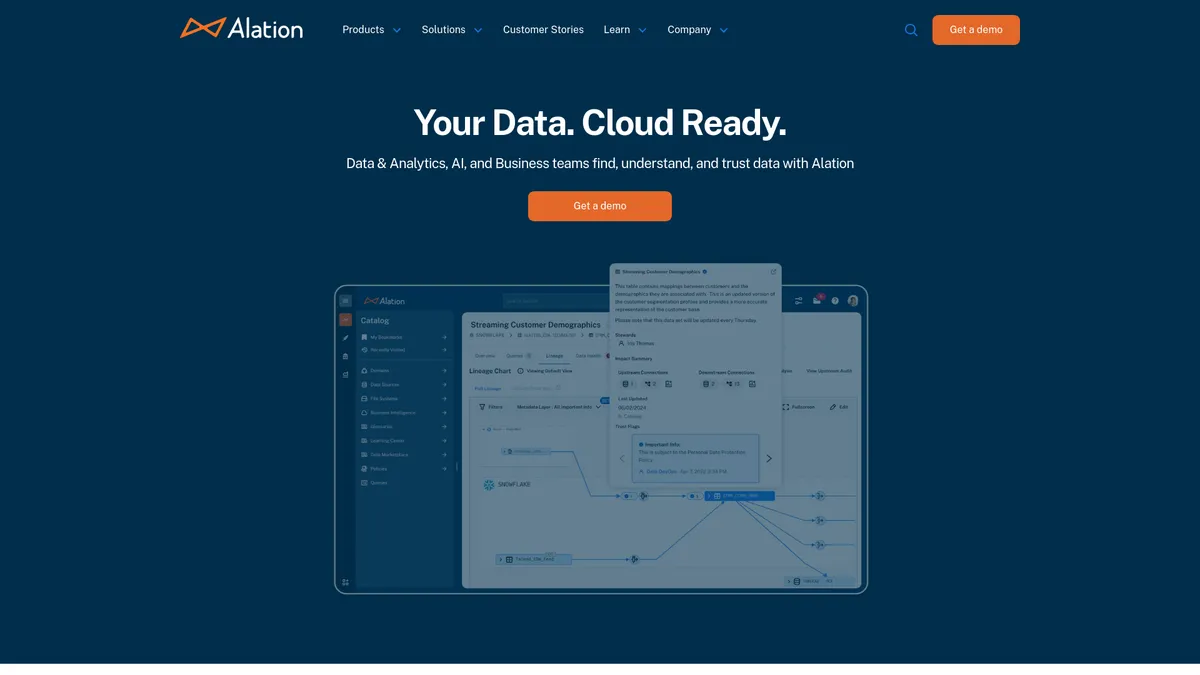
- Data Lineage: Visualizes upstream and downstream dependencies across systems like Informatica. The visual map becomes difficult to read when pipelines exceed 50 nodes.
- Active Data Governance: Manages stewardship tasks and policy documentation. The workflow engine feels rigid compared to dedicated project management tools.
- Data Health Monitoring: Integrates with tools like Soda to display real-time quality scores. It does not fix data quality issues natively.
Alation Pros and Cons
Pros
- Natural language search capabilities allow business users to find relevant data across complex silos without writing SQL.
- The broad connector library supports both legacy on-premise databases like Teradata and modern cloud warehouses like Snowflake.
- The Compose tool speeds up SQL writing for analysts by offering shared query snippets and execution history.
- Collaborative Articles help teams document tribal knowledge that standard technical metadata cannot capture.
- High scalability allows Fortune 500 companies to manage petabytes of metadata with consistent search performance.
Cons
- The $60,000 annual starting price puts the platform entirely out of reach for small and mid-sized businesses.
- Setting up initial data connectors requires heavy engineering involvement and takes weeks to complete.
- The user interface feels cluttered and overwhelms non-technical business users during their first few weeks.
- Lineage visualization turns into an unreadable web when mapping highly complex data pipelines.
Who Should Use Alation?
- Enterprise Data Stewards: You need a centralized platform to enforce data quality and compliance policies across hundreds of databases.
- Data Analysts: You want a single interface to search for trusted datasets and write SQL queries collaboratively.
- Cloud Migration Teams: You must identify redundant or obsolete datasets before moving on-premise data to AWS or Azure.
- Small Business Owners: This tool is not for you. The high cost and complex setup make it completely impractical for small teams.
Alation Pricing and Plans
Alation uses a custom pricing model that requires contacting their sales team.
The entry point is steep.
The Enterprise Subscription starts at $60,000 per year, which breaks down to $5,000 per month. This base price covers core data cataloging, discovery, and governance features. Costs scale up based on user seats and connected data sources.
Developers can access a Free Tier API. This provides a one-time limit of 2,000 Aggregated Context API calls for testing integrations. Once you exhaust this quota, you must upgrade to a custom Paid API Tier.
How Alation Compares to Alternatives
Similar to Collibra, Alation targets large enterprises with complex data governance needs. Collibra focuses heavily on strict compliance workflows and policy management. Alation prioritizes data discovery and collaboration for analysts (we noticed analysts prefer Alation for its built-in SQL editor). Collibra often requires more manual setup for its business glossary.
Unlike Atlan, Alation supports a massive range of legacy on-premise databases alongside modern cloud tools. Atlan caters specifically to modern data stack users on platforms like Snowflake and dbt. Atlan offers a cleaner user interface that non-technical users adopt faster. Alation wins on sheer scale for older, hybrid environments.
The Best Fit for Enterprise Data Teams
Alation delivers immense value to large organizations struggling to track data across hybrid environments. Enterprise data stewards and analytics leaders gain a centralized hub to verify data trust and track lineage.
Small teams and startups should look elsewhere. The $60,000 starting price and heavy engineering requirements create an impossible barrier for budget-conscious users. If you run a modern cloud-only data stack, Atlan provides a much faster setup and a friendlier interface.
The biggest unknown remains how well Alation will simplify its user interface for non-technical business users.