



What is Bonita?
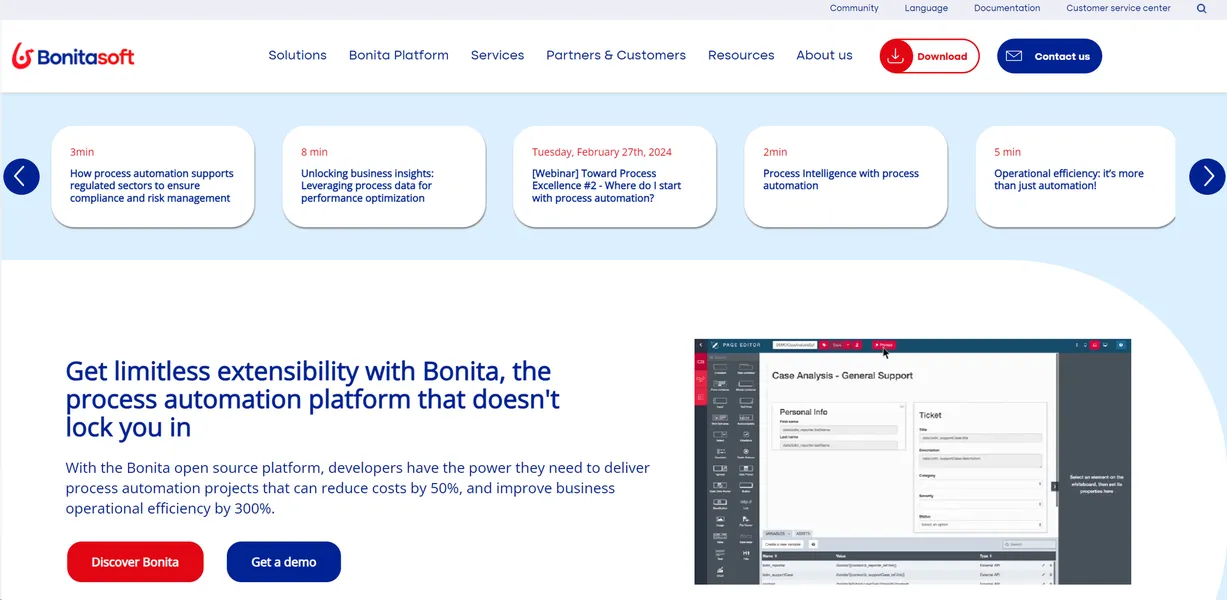
Bonita is an open-source business process management platform that combines low-code visual design with traditional coding capabilities. It helps enterprise teams automate complex workflows like customer onboarding and invoice reconciliation. Developers use its visual drag-and-drop interface and BPMN 2.0 compliance to build custom applications. The software includes a form builder with 30 widget types for data validation. Users can track KPIs and identify bottlenecks using the built-in process analytics engine.
Bonitasoft built this tool to bridge the gap between business analysts and technical developers. The platform targets mid-market and enterprise organizations that need custom automation without building applications from scratch. Users can integrate legacy systems and third-party applications through REST APIs and webhook connectors.
- Primary Use Case: Designing and deploying BPMN 2.0 compliant enterprise workflows.
- Ideal For: Mid-market IT teams and business analysts.
- Pricing: Starts at $500 (subscription) with a free Community Edition.
Key Features and How Bonita Works
Visual Process Design and Forms
The platform provides a visual process designer for non-technical users.
- Drag-and-drop interface: Allows users to map workflows, limited to 30 widget types.
- BPMN 2.0 compliance: Ensures vendor-neutral process portability across different platforms.
- Mobile-responsive case management: Displays real-time task notifications on mobile devices.
Enterprise Integrations and APIs
Bonita connects to external systems using standard protocols.
- Built-in connectors: Supports 50 enterprise applications like Salesforce and ServiceNow.
- REST API with JSON support: Connects custom systems but requires Java knowledge for extensions.
- Database connectivity: Connects to PostgreSQL, MySQL, Oracle, and SQL Server using built-in query builders.
Deployment and Analytics
Teams can monitor and deploy applications across different environments.
- Process analytics engine: Tracks KPIs and cycle times but lacks predictive AI modeling.
- Deployment options: Offers single-tenant cloud or self-hosted on-premise infrastructure.
- Role-based access control: Manages granular permissions for organizations with over 1000 users.
Bonita Pros and Cons
Strengths
- Free Community Edition has no user limits, saving licensing costs for small organizations.
- BPMN 2.0 compliance ensures processes remain vendor-neutral and portable to competing platforms.
- Pre-built connectors reduce custom development time by 40 to 60 percent versus manual coding.
- Active open-source community with 500 GitHub contributors provides plugins and regular security updates.
- Low-code approach enables business analysts to build basic workflows without Java programming knowledge.
Limitations
- Cloud hosting stability issues cause downtime affecting production processes requiring strict uptime guarantees.
- Enterprise edition pricing scales high, reaching $50,000 annually for mid-market deployments.
- Documentation gaps and sparse API examples make complex integrations difficult for new developers.
- Platform lacks built-in AI capabilities compared to newer competitors like Appian and Microsoft Power Automate.
Who Should Use Bonita?
- Budget-conscious IT teams: The Community Edition provides unlimited user access without licensing costs.
- Business analysts: The low-code approach allows non-technical staff to build basic workflows.
- Enterprise developers: Technical users can write custom Java code and REST APIs for complex logic.
- Not for small businesses needing AI: Teams wanting out-of-the-box AI automation should look at UiPath instead.
Bonita Pricing and Plans
The Community Edition is free forever. It includes unlimited users, core features, and open-source access. This is a real free tier, not a disguised trial.
Subscription Editions start at $500 per month billed annually. This tier adds advanced features, dedicated support, and cloud hosting options.
Enterprise plans require custom pricing. These plans include dedicated SLA and on-premise deployment support (costs exceed $50,000 annually at scale).
Organizations can test the platform using the Community Edition before committing to a paid plan. The open-source codebase lives on GitHub, allowing developers to inspect the architecture.
How Bonita Compares to Alternatives
Similar to Appian, Bonita targets enterprise process automation. Appian includes native AI capabilities and a polished interface. Bonita offers a true open-source Community Edition with unlimited users. Appian charges strict per-user licensing fees that price out smaller organizations.
Teams wanting a free starting point prefer Bonita.
Unlike Salesforce Flow, Bonita operates as a standalone BPM platform. Salesforce Flow works best for teams already locked into the Salesforce ecosystem. Bonita connects to multiple databases like PostgreSQL and Oracle using standard BPMN 2.0 models (the form builder feels dated compared to modern web frameworks).
Teams needing vendor-neutral process portability prefer Bonita.
UiPath Automation Cloud targets robotic process automation for repetitive tasks. Bonita handles human-in-the-loop workflows and complex approval chains. UiPath handles screen scraping and legacy system interaction. Bonita orchestrates multi-step business processes across different departments.
The Best Fit for Bonita
Bonita delivers high value for mid-market IT teams that want open-source flexibility and BPMN 2.0 compliance. Organizations needing advanced AI automation or guaranteed cloud uptime should look elsewhere. Teams invested in the Microsoft ecosystem should consider Microsoft Power Automate instead.