



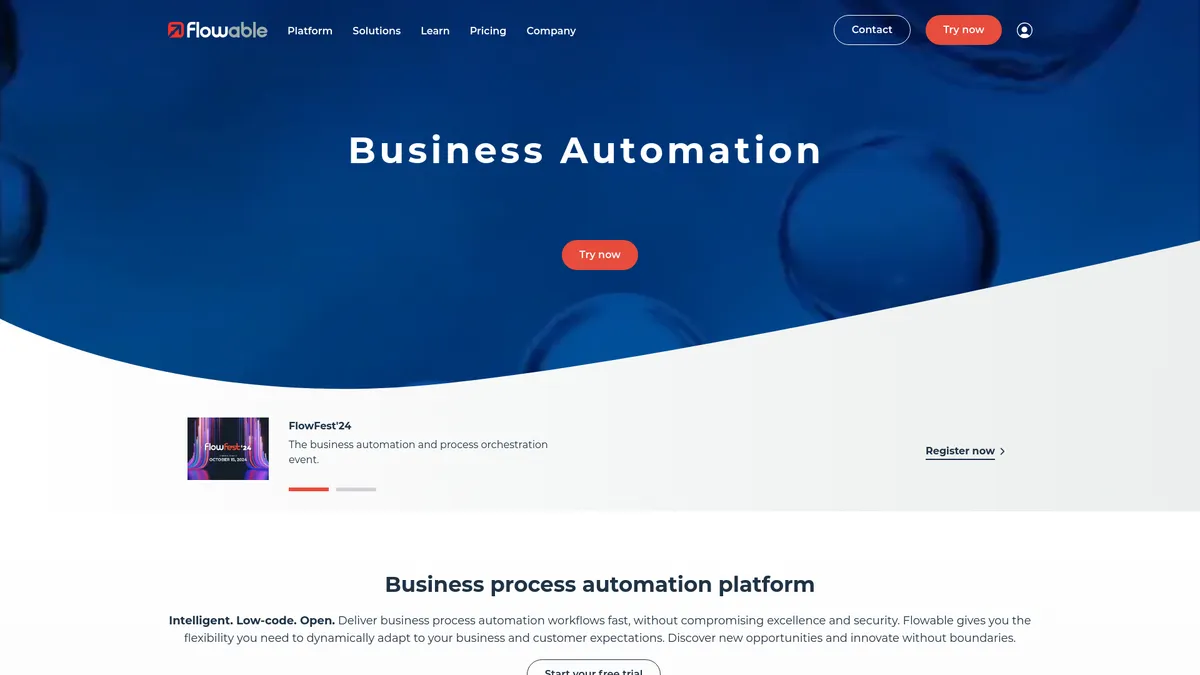
What is Flowable?
Private banks lose up to 30 percent of new clients during the standard 45-day onboarding process. Manual document review and compliance checks create massive bottlenecks for financial institutions.
Flowable, developed by Flowable, is an agentic AI platform that targets this exact problem. It acts as a case management layer for regulated industries. The software coordinates multiple AI agents to handle administrative workflows like source-of-wealth verification. Due diligence officers use it to automate data extraction while maintaining final approval authority.
- Primary Use Case: Automating source-of-wealth verification and complex due diligence workflows.
- Ideal For: Enterprise compliance teams and private banking institutions.
- Pricing: Starts at Custom Pricing (Enterprise) with no public tiers available.
Key Features and How Flowable Works
Multi-Agent Orchestration
- Agent Coordination: The platform deploys up to 20 specialized AI agents to handle different parts of a single workflow. It limits concurrent agent runs based on your custom server capacity.
- Case Management System: It tracks exceptions and routes them to human workers. The system requires manual configuration for confidence thresholds before deployment.
Compliance and Governance
- Human-in-the-loop Checkpoints: The software pauses workflows for mandatory human approval. It cannot finalize compliance decisions without a verified user sign-off.
- Data Permissioning Layer: It restricts document access based on user roles. Administrators must map out all access controls manually during setup.
- Chain-of-thought Dashboard: It displays the exact logic the AI used to reach a conclusion. The dashboard only stores these logs for a contracted retention period.
Document Processing
- Natural Language Processing: The tool extracts unstructured data from complex PDFs (like tax returns or trust deeds). It struggles with handwritten notes or heavily degraded scans.
- Public Records Cross-referencing: It checks extracted data against external databases. This feature depends entirely on the API limits of your chosen third-party data providers.
Flowable Pros and Cons
Strengths
- Reduces processing time by 95 percent, dropping source-of-wealth verification from 45 days to just two days.
- Improves customer retention significantly, cutting client churn from 30 percent to under 1 percent in banking case studies.
- Scales administrative output without requiring new headcount for data entry tasks.
- Maintains strict enterprise compliance through mandatory human oversight checkpoints.
Limitations
- Lacks transparent public pricing or self-serve trial options.
- Requires massive upfront architecture design for data permissioning before deployment.
- Demands specialized internal expertise to manage agentic AI workflows safely.
This heavy setup phase often delays initial deployment by several months.
Who Should Use Flowable?
- Enterprise Banking Teams: Private wealth managers can use this to speed up client onboarding and verify assets quickly.
- Compliance Officers: Regulated departments benefit from the strict audit trails and mandatory human approval steps.
- Small Business Owners: This tool is not a good fit for small teams. The custom enterprise pricing and complex setup require dedicated IT resources.
Flowable Pricing and Plans
Flowable operates entirely on a custom enterprise pricing model. The company does not publish standard rates or offer a free trial. Buyers must contact sales to negotiate a contract based on their specific workflow volume and agent requirements.
The Enterprise plan includes orchestrated multi-agent workflows, human-in-the-loop oversight, and the core case management layer. You will likely pay significant implementation fees (often reaching six figures) to configure the initial data permissioning architecture.
Choosing the right automation platform depends entirely on your technical resources.
How Flowable Compares to Alternatives
Similar to UiPath, Flowable automates repetitive administrative tasks to save time. Unlike UiPath, which relies heavily on rigid robotic process automation scripts, Flowable uses generative AI agents that adapt to unstructured data. UiPath works better for simple screen scraping, while Flowable handles complex reasoning tasks like reading tax returns.
Automation Anywhere is another major competitor in the enterprise automation space. Automation Anywhere offers more transparent pricing tiers and a broader marketplace of pre-built bots. Flowable focuses specifically on case-based orchestration for highly regulated industries, making it a more specialized choice for banking compliance.
Verdict: The Ideal Enterprise Compliance Solution
Flowable delivers massive time savings for large financial institutions struggling with manual due diligence. If you manage a private bank and lose clients to slow onboarding, choose this platform. The human-in-the-loop governance keeps you compliant while agents do the heavy lifting.
If you run a small business or need simple task automation, look elsewhere. The heavy upfront architecture and hidden pricing make it overkill for basic needs. Smaller teams should consider UiPath for straightforward automation without the enterprise price tag.