



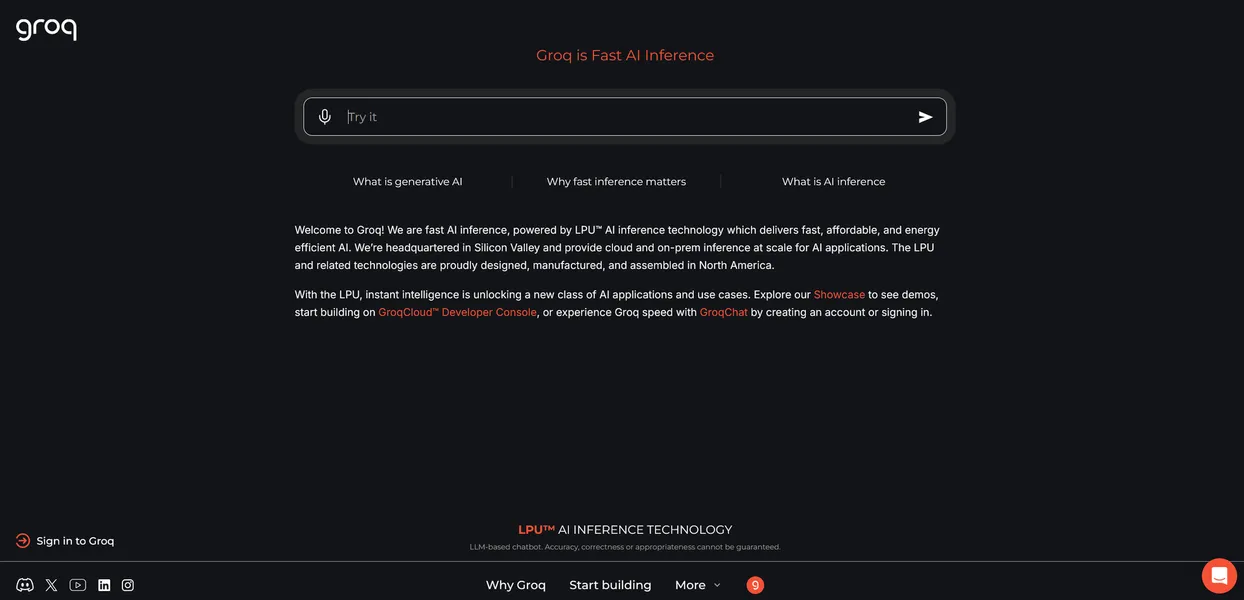
What is Groq?
Groq is an AI inference engine that runs open-weight models at extreme speeds. It replaces traditional graphics processing units with custom silicon built for language generation. This hardware is called a Language Processing Unit. You get sub-second response times for models like Llama 3.1 and Mixtral. The system processes tokens sequentially to maximize throughput.
Groq, Inc. built this platform to solve the latency problem in generative AI. Standard cloud providers struggle to deliver text fast enough for real-time voice agents. Developers building interactive chatbots use Groq to eliminate awkward pauses during conversations. The API structure mimics OpenAI to make migration simple. You just change the base URL and API key in your existing code.
- Primary Use Case: Building real-time conversational AI chatbots requiring sub-second latency.
- Ideal For: Developers building agentic workflows and live translation apps.
- Pricing: Starts at $0.01 (Pay-as-you-go): Usage-based pricing per token consumed.
Key Features and How Groq Works
Hardware and Architecture
- LPU Architecture: Proprietary hardware designed for deterministic sequential processing. This silicon avoids the memory bottlenecks found in standard GPUs. Limited to Groq data centers.
- Deterministic Performance: Consistent latency regardless of model load. You get the exact same response time during peak hours. Limited by network latency between the user and the server.
- Rate Limit Management: A detailed dashboard tracks your Requests Per Minute and Tokens Per Day. You can monitor usage spikes in real time. Limited to basic metrics without advanced cost forecasting.
Model Support and Integration
- Native Model Hosting: Runs Llama 3.1, Gemma 2, and Mixtral 8x7B. These models load instantly into the LPU memory. Limited to open-weight models.
- OpenAI Compatibility: API endpoints match the OpenAI structure exactly. You can use existing OpenAI libraries to call Groq models. Limited to text and vision endpoints supported by hosted models.
- Python and Node.js SDKs: Official libraries for code integration. These packages handle authentication and retries automatically. Limited to these two primary languages for official support.
Advanced Capabilities
- Whisper Integration: Speech-to-text processing using Whisper Large V3. The system transcribes audio files with near-instant turnaround times. Limited by audio file size upload caps.
- Tool Use: Function calling for external API interaction. The models can trigger database queries or web searches. Limited by the specific model instruction-following accuracy.
- Vision Capabilities: Multimodal image analysis via Llama 3.2 Vision. You can pass images to the model for detailed descriptions. Limited to specific image formats and resolutions.
Groq Pros and Cons
Pros
- Generates over 500 tokens per second on Llama 3 8B.
- Time-to-first-token is low enough for real-time voice applications.
- Pay-as-you-go pricing costs less than standard GPU cloud providers.
- OpenAI compatible API structure makes migration fast and simple.
- High reliability for production workloads with dedicated enterprise support.
Cons
- Model selection excludes proprietary options like GPT-4o.
- Free tier rate limits cause frequent 429 errors during testing.
- No fine-tuning support for custom model weights.
- Vision capabilities remain limited compared to dedicated multimodal platforms.
Who Should Use Groq?
- Voice AI Developers: Voice agents require instant responses to feel natural. Groq provides the necessary speed to eliminate awkward silences.
- High-Volume Data Processors: Teams running millions of documents through Llama 3.1 save money and time. The high throughput processes massive datasets in minutes.
- Live Translation Builders: Applications translating speech in real time need low latency. The LPU architecture handles this continuous stream of text easily.
- Generalist Enterprise Teams: Companies needing a single provider for all AI tasks should look elsewhere. Groq lacks proprietary frontier models and fine-tuning capabilities.
Groq Pricing and Plans
The Free Tier costs $0 per month. It provides access to all supported models but imposes strict Requests Per Minute and Tokens Per Day limits. You do not need a credit card to start.
You will hit these limits fast during active development.
(I triggered a rate limit error within ten minutes of testing a basic agent loop).
The Developer Tier uses a pay-as-you-go model. Prices start around $0.01 per million tokens depending on the specific model. This tier increases rate limits for production use. You only pay for the exact compute you consume. The pricing structure undercuts major cloud providers running standard NVIDIA hardware.
The Enterprise Tier requires custom contracts. It targets high-volume production workloads requiring dedicated capacity and custom rate limits. You get guaranteed uptime and direct technical support from the engineering team.
How Groq Compares to Alternatives
Together AI offers a much wider selection of open-weight models. You can access specialized coding models and older Llama versions. Groq restricts its catalog to a few optimized models to guarantee speed. Together AI uses standard GPUs, which means slower inference speeds for most tasks.
Anyscale provides similar API access to open models but focuses on custom fine-tuning. You can train your own model weights on Anyscale infrastructure. Groq only serves base models and instruction-tuned variants provided by the original developers. Anyscale fits better for teams building highly specialized domain models.
Perplexity AI focuses on search and retrieval-augmented generation. It provides answers with cited sources from the live web. Groq provides raw inference compute for developers to build their own applications. You must build your own retrieval system if you use Groq.
The Speed-First Developer Verdict
Groq delivers the fastest inference available for Llama 3.1 and Mixtral. Developers building real-time voice agents or high-speed data pipelines get immediate value. The LPU hardware changes how interactive applications feel. The cost savings on the pay-as-you-go tier make it an easy choice for high-volume text processing.
Teams requiring GPT-4o or Claude 3.5 Sonnet must look elsewhere.
If you need to fine-tune open models before running them, choose Anyscale instead.