



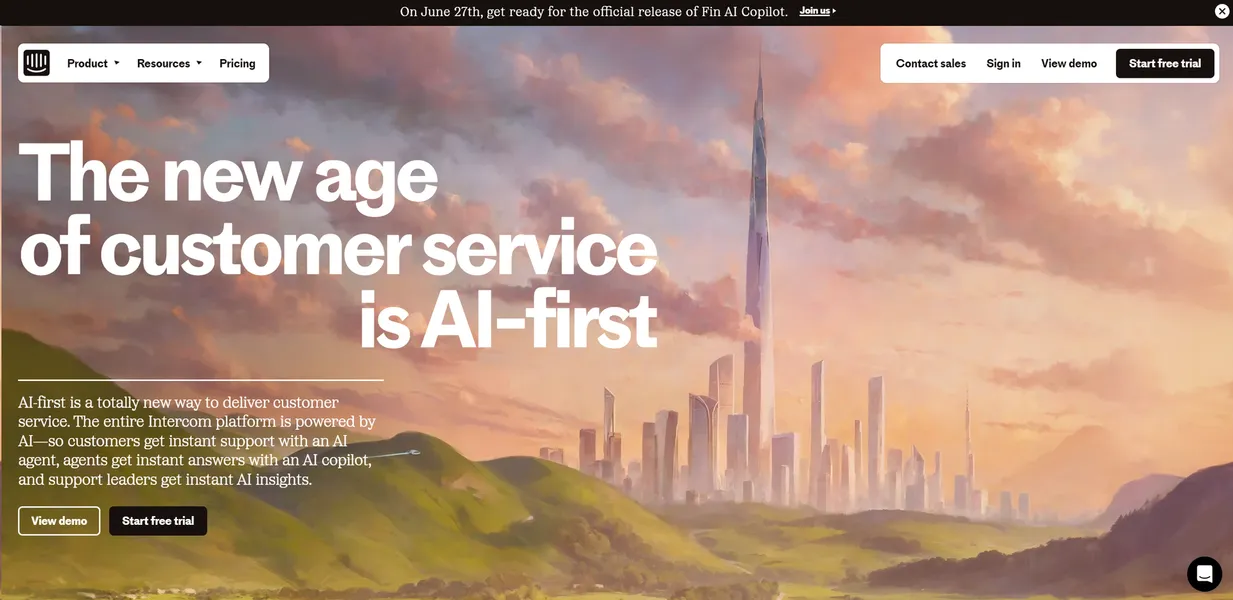
What is Intercom?
Intercom charges you $0.99 every time its AI successfully answers a customer question. This usage-based pricing model shifts the focus from software seats to actual work completed.
Developed by Intercom, Inc., this customer service platform automates support, sales, and marketing communications. It targets software companies that want to reduce human staff in their support departments. The system replaces basic ticketing with conversational AI agents and automated workflows.
- Primary Use Case: Automating 24/7 customer support using GPT-4 to resolve queries without human intervention.
- Ideal For: Mid-market SaaS companies with high support ticket volumes.
- Pricing: Starts at $29 billed annually (Essential plan) – Requires additional $0.99 per AI resolution.
Key Features and How Intercom Works
AI Resolution and Agent Assistance
- Fin AI Agent: Resolves customer queries using GPT-4. Costs $0.99 per successful resolution.
- Fin AI Copilot: Summarizes long conversations and drafts replies for human agents. Limited to internal agent use.
Omnichannel Inbox and Routing
- Shared Inbox: Centralizes messages from Email, WhatsApp, Facebook, and Instagram. Requires manual setup for each channel.
- Workflow Builder: Routes tickets and triggers custom logic using a visual editor. Complex branching requires the Advanced plan.
User Onboarding and Lead Capture
- Custom Bots: Qualifies inbound sales leads with 10+ logic blocks. Data collection limits depend on your CRM integration.
- Product Tours: Creates interactive onboarding guides for web applications. Does not support native mobile app tours.
Intercom Pros and Cons
Pros
- Consolidates 10+ communication channels into one dashboard to reduce context switching.
- Fin AI Agent achieves resolution rates exceeding 50% for standard support queries.
- Messenger UI accepts custom colors and styles to match specific brand guidelines.
- Visual automation engine handles complex routing logic without requiring developer resources.
- App Store includes 350+ pre-built integrations for syncing data with Salesforce and HubSpot.
Cons
- Fin AI resolution fees create unpredictable monthly billing for high-volume users.
- Setting up multi-branching bots requires a steep learning curve for new administrators.
- Intercom customer support relies on automated bots and takes days to respond to complex issues.
- Advanced workflow automation requires the $99 per seat tier.
Who Should Use Intercom?
- Mid-market SaaS teams: Software companies can use product tours and custom bots to onboard new users without human input.
- High-volume support departments: Teams drowning in repetitive queries benefit from Fin AI handling basic password resets and billing questions.
- Budget-conscious solo founders: Small startups will find the $39 per seat base price and $0.99 AI fees too expensive.
Intercom Pricing and Plans
Intercom offers three paid tiers and no free plan. The Essential plan costs $39 per seat monthly ($29 billed annually) and includes core support, the Messenger, and a Shared Inbox. The Advanced plan jumps to $99 per seat monthly ($85 billed annually). This tier adds workflow automation, Salesforce integrations, and 20 lite seats.
The Expert plan costs $139 per seat monthly ($132 billed annually). It provides SSO, HIPAA compliance, and 50 lite seats.
Every plan requires a separate usage fee for the Fin AI Agent.
Intercom charges $0.99 for every query the AI resolves successfully (which feels expensive for simple questions).
How Intercom Compares to Alternatives
Similar to Zendesk, Intercom provides a central hub for customer communications. Zendesk focuses on traditional email ticketing and IT service management. Intercom prioritizes real-time chat and proactive in-app messaging. Zendesk offers a more predictable pricing model for large enterprise teams.
Unlike Drift, which targets B2B sales teams, Intercom balances sales features with heavy customer support capabilities. Drift excels at booking meetings for account executives through complex chat playbooks. Intercom handles post-sale onboarding and technical support much better than Drift.
Help Scout competes directly with Intercom on shared inbox functionality. Help Scout costs less and offers a simpler interface for basic email support. Intercom justifies its higher price with advanced GPT-4 chatbots and complex behavioral targeting.
The Verdict for High-Volume Support Teams
Intercom delivers massive value to mid-market software companies that want to automate their support queues.
The Fin AI agent works well.
It deflects enough tickets to justify the $0.99 per resolution fee for most SaaS businesses (I found the setup process confusing at first). Small businesses with low ticket volumes should look elsewhere. The base seat costs and complex setup process create too much friction for simple email support.
If you just need a shared inbox for a small team, Help Scout provides a cheaper alternative.
Within 12 months, Intercom will likely shift to outcome-based pricing, abandoning per-seat licenses as AI handles the majority of customer interactions.