



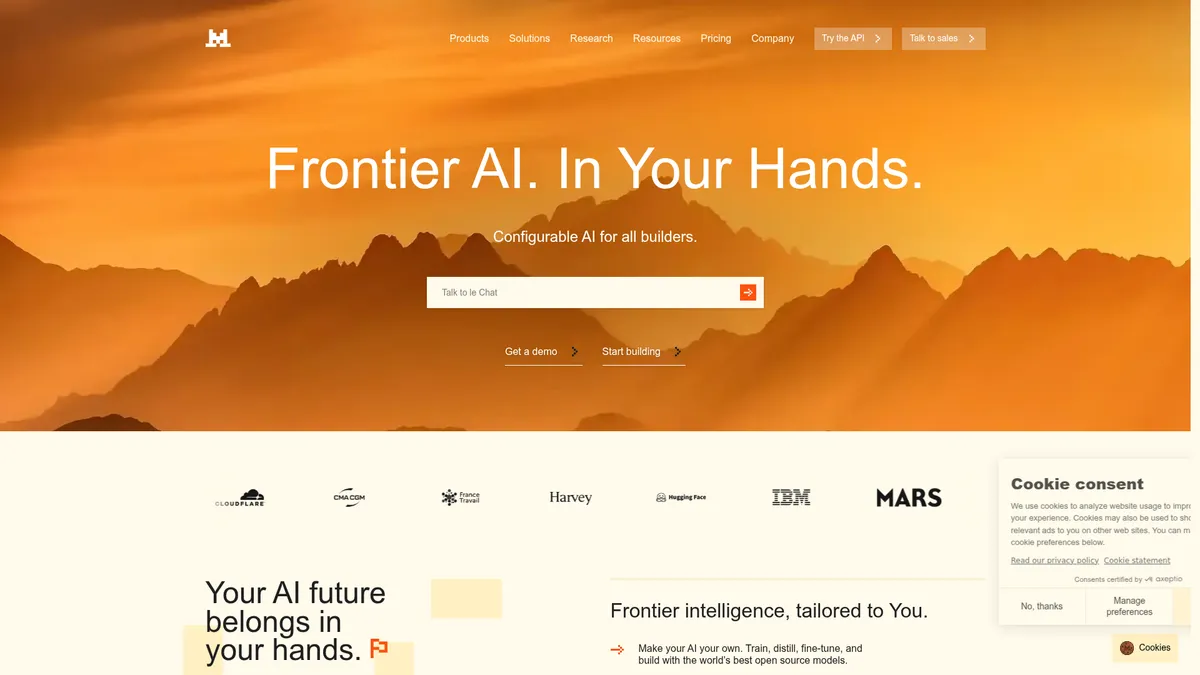
What is Mistral AI?
Developers expected another closed ecosystem when European AI startups began raising billions. They got a hybrid model instead. Mistral AI releases highly capable open-weight models alongside premium proprietary APIs. This approach gives engineering teams a choice between local control and managed convenience.
Mistral AI SAS builds these models to solve enterprise data privacy concerns. The Paris-based company targets software developers and enterprise IT teams. Their models process text and code across multiple languages with lower latency than older architectures.
- Primary Use Case: Deploying open-weight language models on private infrastructure for strict data privacy.
- Ideal For: Enterprise developers and security-conscious engineering teams.
- Pricing: Starts at $14.99 (Pro) (Free tier available) – The API costs significantly less than GPT-4 for similar outputs.
Key Features and How Mistral AI Works
Model Access and Deployment
- Open-Weight Models: You can download Mistral 7B and Mixtral 8x7B for local hosting. You must manage your own hardware and scaling.
- Cloud Deployment: The models run on Azure, AWS Bedrock, and Google Cloud. Setup requires existing cloud infrastructure knowledge.
- La Plateforme API: This RESTful API handles text generation and embeddings. Rate limits apply based on your usage tier.
Coding and Vision Capabilities
- Codestral: This specialized model generates code across 80 programming languages. It struggles with highly obscure legacy languages.
- Pixtral: The vision model processes images alongside text prompts. It cannot generate new images.
- JSON Mode: The API guarantees valid JSON output for software integration. Complex nested schemas sometimes require prompt adjustments.
User Interfaces and Customization
- Le Chat: The web interface allows direct interaction with all models. The free tier restricts daily message volume.
- Self-Service Fine-Tuning: You can adapt models to specific domains using your own data. The documentation lacks examples for advanced edge cases.
- Custom Agents: Users can configure AI agents for specific workflows. These agents lack the deep third-party app integrations found in competing products.
Mistral AI Pros and Cons
Pros
- Mistral 7B outperforms Llama 2 13B on standard benchmarks while using fewer compute resources.
- Open-weight availability allows teams to host models locally for complete data security.
- API pricing undercuts GPT-4 significantly while maintaining comparable performance on reasoning tasks.
- The company complies with EU data regulations (a major advantage for European enterprises).
- Optimized architecture delivers fast inference and low latency for real-time applications.
Cons
- The ecosystem offers fewer third-party plugins than OpenAI or Anthropic.
- API documentation remains sparse regarding advanced fine-tuning and agent configuration.
- The standard chat interface lacks real-time internet browsing on lower tiers.
Who Should Use Mistral AI?
- Enterprise IT Teams: You need to run capable models on internal VPCs to satisfy compliance requirements.
- Budget-Conscious Developers: You want high-quality API responses without paying premium OpenAI prices.
- Multilingual Support Staff: You build chatbots that must handle native European languages fluently.
- Non-Technical Marketers (Not Recommended): You rely on pre-built plugins and simple web interfaces. You will find the ecosystem too technical.
Mistral AI Pricing and Plans
Mistral AI uses a freemium model with distinct tiers.
The Free plan costs $0 per month. It includes core chat features and 500 memories. This tier imposes strict daily limits on messages and searches. It functions mostly as a trial.
The Pro plan costs $14.99 per month. Users get higher usage limits and 15GB of storage. It supports 1,000 projects and includes Mistral Vibe for coding tasks.
The Team plan costs $24.99 per user per month. It provides 30GB of storage per user. Teams get centralized billing, domain verification, and admin controls.
The Enterprise plan requires custom pricing. It unlocks on-premise deployment, custom models, and full audit logs.
How Mistral AI Compares to Alternatives
Similar to OpenAI, Mistral provides a RESTful API and a consumer chat interface. OpenAI offers a massive plugin ecosystem and superior multimodal capabilities. Mistral counters with open-weight models that you can download and run on your own hardware. OpenAI forces you to send all data to their servers.
Unlike Anthropic, Mistral focuses heavily on European language fluency and open-weight distribution. Anthropic excels at massive context windows and nuanced safety guardrails. Mistral gives developers more raw control over the model weights. Anthropic provides better out-of-the-box formatting for long document analysis.
The Ideal Choice for Privacy-Focused Engineering Teams
Mistral AI delivers massive value to developers who need local deployment. Enterprise teams handling sensitive data benefit the most from the open-weight options. The low API costs also attract solo developers building high-volume applications.
Non-technical users looking for an all-in-one assistant should look elsewhere. OpenAI ChatGPT remains a better fit for users who need web browsing and extensive app integrations.
We still do not know how Mistral will scale its plugin ecosystem.
The core models perform exceptionally well.
The surrounding infrastructure still requires significant technical expertise to use effectively.